MetaM support-server attack exposes customer conversations, including Coinone records
Coinone says an attacker accessed MetaM’s servers and viewed or took support records. Fields varied and could include identity details or passwords shared with support. Coinone found no indication of direct access to its account, trading or wallet systems. Mega MGC Coffee separately confirms 30 exposed mobile phone numbers.
- Disclosed
- Nov 14, 2026
- Updated Nov 17, 2026
- Severity
- Septic Tank Blew
- No CVE: a breach, not a bug
- Splash zone
- Customers whose conversations were stored on affected MetaM systems, including Coinone customers who contacted support
- data breach · customer support · South Korea · crypto
- In the wild
- Yes
What happened
Coinone says an external attacker accessed servers that MetaM operated for outsourced support. Stored support information was viewed or taken. Coinone’s exchange accounts, trading and wallet systems operate separately. Coinone found no indication of direct intrusion into those systems, and its notice gives no confirmed asset-loss figure. Coinone says all logins require a second factor.
Coinone lists the phone number used for support, name, email address, date of birth, bank account number, password, resident registration number, identity document issuance date, home address, wallet address and transaction ID (TXID). These are fields customers may have supplied during chat or phone support. Coinone says the fields vary by person, and customers with no support history are outside the reported scope. A wallet address or TXID alone does not grant control of funds.
MetaM’s reproduced notice says it isolated affected or suspected servers, blocked known attack IPs, rotated administrator credentials and reported the incident to KISA. The initial access method, number of affected customers and total scope across clients remain under investigation. L4 reflects confirmed unauthorized access to live support records and the sensitivity of data in the affected systems.
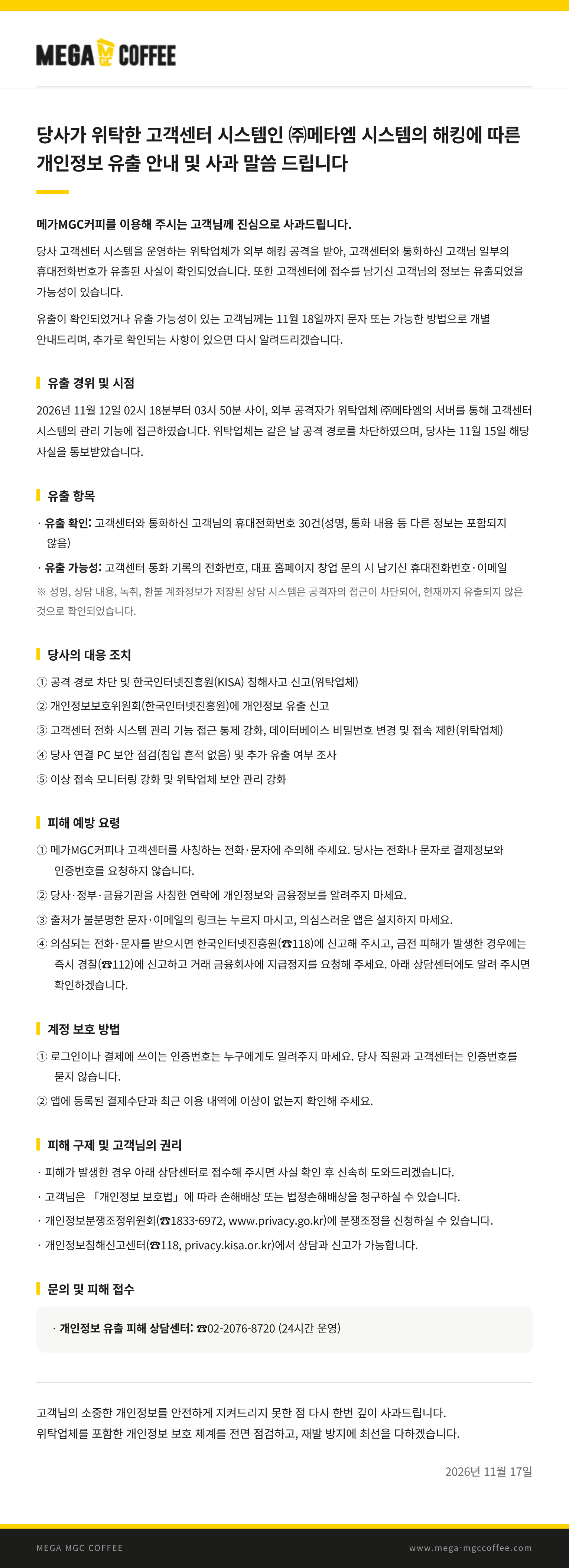
In its November 17 notice, Mega MGC Coffee confirmed exposure of 30 mobile phone numbers belonging to people who phoned its support center. Phone numbers in call records and mobile numbers and emails supplied with franchise inquiries through its website may also be affected. The brand says the system holding names, conversation contents, recordings and refund account information was protected from attacker access. The brand reports no evidence those records leaked. MetaM blocked the attack route on November 12 and notified the brand on November 15. The brand says MetaM tightened access controls, changed database passwords and restricted connections. It plans individual notifications by November 18. The count covers the mobile numbers this brand has confirmed as exposed.
Crime-scene timeline
Nov 12, 2026
Coinone learns of unauthorized access to MetaM servers
Coinone dates the unauthorized access and its notification from the contractor to November 12. It moved outsourced support to email and blocked access paths.
Nov 13, 2026
MetaM reports the incident to KISA
MetaM’s reproduced notice dates its report to the Korea Internet and Security Agency to November 13.
Nov 14, 2026
MetaM announces exposure in some outsourced support systems
The public reproduction of the notice describes unauthorized viewing or removal of phone numbers and conversations and an ongoing scope investigation.
Nov 15, 2026
Coinone identifies potentially exposed support data
Coinone lists 11 possible data fields and says it is preparing individual notices or a lookup service. It excludes customers with no support history and gives no affected-customer count.
Nov 17, 2026
Mega MGC Coffee confirms exposure of 30 mobile phone numbers
The brand was notified on November 15 and plans to contact confirmed or potentially affected customers by November 18.
Who said what
We list each claim and who made it. Primary sources (the vendor, the researcher, the registry) are marked. Where reports disagree, we grade by the worst credible case.
- Coinone customer noticePrimaryConfirms contractor-server access, lists potentially exposed fields, distinguishes Coinone’s own systems and gives account protection steps.
- Public reproduction of MetaM’s November 14 noticeReproduces the contractor’s popup notice on service scope, server isolation, customer notifications and the continuing investigation.
- Mega MGC Coffee official incident noticePrimaryConfirms exposure of 30 mobile numbers and describes other possible fields, notifications and containment.